
What Is Surah Taha and Its Main Theme?
Surah Taha is the 20th chapter of the Quran which was revealed in the early years of Islam. So, the main theme of this surah is to console weak Muslims and increase their faith on divine plan.
Surah Taha basically explains the story of Prophet Musa and Prophet Adam while bringing up the life lessons. So, this post is all about a complete overview of translation and Tafsir of this surah and the ways how one can add this surah into the routine. So, let's read ahead.
What does the word "Taha" Mean?
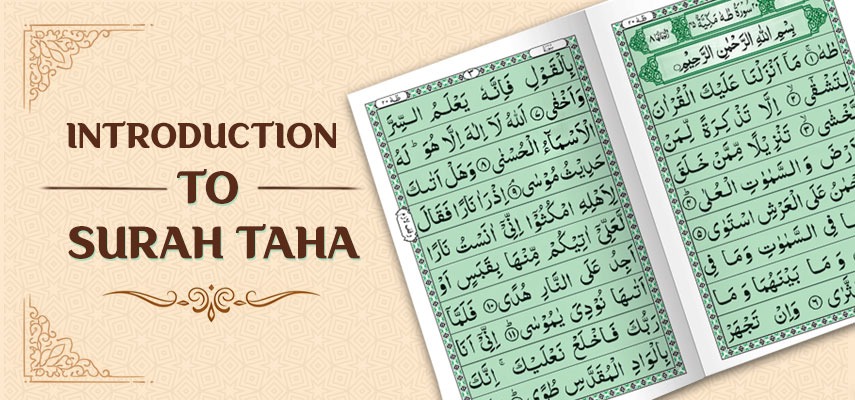
The word "Taha" (طه) is an Arabic word made of Ta (ط) and Ha (ه). It belongs to the special type of Quranic words known as "Huruf Muqatta'at (separate letters). Actually, Allah knows the exact meaning of this word and no one else. But many scholars used to ponder over this and came up with closely accepted meanings.
Some scholars thought that it's just a linguistic style of the Quran that Allah used to draw the attention of the listeners. While others think that it's just a gentle form of address to the Holy Prophet in the meaning of " O man" or " O beloved". And the very next ayah after this word also supports this idea. In simple words, the word " Taha" is a powerful introduction of the Surah that guides towards the actual message of this surah.
The Revelation of Surah Taha
Surah Taha is among those chapters of the Quran that Allah revealed during the early years of Islam. So, it's a Meccan Surah and was revealed when the Holy Prophet and his companions (early Muslims) were facing strong opposition from leaders of Makkah. They used to threaten and oppress early Muslims so that they abandon their faith. This is also the reason why the Holy Prophet was deeply concerned about his followers.
In this difficult situation, the Surah Taha was revealed to console the Holy Prophet and his followers. First of all, Allah clarified the status of the revelation of the Quran to the Holy Prophet that it was revealed to guide people but not to cause you distress.
Similarly, the following messages of the Surah from the stories of Hazrat Musa and Hazrat Adam were about patience and hope in Allah. The purpose of this surah was mainly to remind the Prophet that you are not alone as the earlier Prophets also faced these similar challenges. And it's the patience and faith in Allah that guides towards success.
Structure and Overview of Surah Taha
Surah Taha was revealed with a purpose. So, it has a clear structure and flow that heals the oppressed hearts. It begins with a direct consolation message for the Holy Prophet with the following stories of Prophet Musa and Prophet Adam full of lessons and guidance for all. Here's a simple overview of the structure of Surah Taha:
- Opening and Purpose of the Quran (Verses 1–8).
- Calling of Prophet Musa at Mount Tur (Verses 9–24).
- Mission to Pharaoh (Verses 25–36).
- Signs Given to Musa (Verses 37–48).
- Musa and Harun Confront Pharaoh (Verses 49–76).
- Magicians Accept the Truth (Verses 77–79).
- Rescue of Bani Israel (Verses 80–82).
- Story of the Golden Calf (Verses 83–98).
- Story of Adam and Iblis (Verses 99–123).
- Warnings About the Day of Judgment (Verses 124–127).
- Lessons from Past Nations (Verses 128–129).
- Comfort to Prophet Muhammad (Verses 130–132).
- Final Reminder About the Quran (Verses 133–135).
Translation and Tafsir of Surah Taha
Below is the whole explanation of Surah Taha and all the messages and lessons that we should understand while reading this surah. With this, you'll get an idea of the whole Surah and the pattern and wisdom of the topics coming one after another.

However, find word-by-word translation through authentic sources if you are looking for ayah-to-ayah analysis.
Opening Verses: Comfort for the Holy Prophet
The opening verses of Surah Taha clearly state the purpose of revelation of this Surah. Surah Taha starts with a clear reminder that Allah didn't reveal this Quran to make it a burden for you. In fact, Allah sent it as a guidance for people who are willing to listen and respond to it. This message was very important at that time because all the believers including the Prophet were facing rejection and criticism from disbelievers.
Even nowadays, this message has the same effect and reassurance. These verses are strong reminders for readers that faith doesn't feel like a burden. In fact, it's the sincere effort in doing good which ultimately matters.
Even it's a purposeful reminder for preachers of Islam as they aren't responsible for the guidance of everyone. Allah is the only one who puts the light of guidance in the hearts and messengers just have to convey the message.
The Story of Hazrat Musa in Surah Taha
The story of Prophet Musa is a core theme of surah Taha full of life lessons for believers. This Surah explains the life of Prophet Musa starting from his birth and miraculous upbringing to his marriage, call to prophethood and confrontation with Pharaoh. So, here is the entire story and the life lessons to understand:
Early Life of Hazrat Musa
When Hazrat Musa born centuries ago, it was the time when Pharaoh was the king of Egypt and he had ordered to kill all the newborn boys of Bani Israel. It's because of the fear he had deep in his heart that a boy from Bani Israel would challenge his power and status one day.
In this situation, Allah put an order in the heart of Musa's mother that she place her baby in a basket and let it float on the river Nile. This divine inspiration wasn't out of wisdom and empathy. In fact, Allah had the better plan for both of them. And eventually, the wife of Pharaoh found Hazrat Musa from the river and started raising him as her son.
Hazrat Musa grew into adulthood in the palace of Pharaoh and also became aware of the oppression that his nation (Bani Israel) faced at that time. And because of this empathy, Hazrat Musa also killed an Egyptian man unintentionally while trying to save an Israelite. But later on, he left Egypt out of fear and traveled to Madyan. He spent almost 10 years in Madyan and also get married there.
Confrontation with Pharaoh
Hazrat Musa returned from Madyan after 10 years through a forest. It was the time when he saw a fire on Mount Tur. So, he approached Mount Tur to get the fire as a savior to spend the night in the forest. It was the time when Allah directly spoke to him and appointed him as a Prophet.
The mission was to confront Pharaoh and call him towards Allah. But Hazrat Musa requested Allah to strengthen him through his Brother (Haroon) which Allah accepted and made Haroon the Prophet as well. However, Pharaoh rejected the message at all out of his power and arrogance. Also, Pharaoh questioned his authority and upbringing in the palace.
But Prophet Musa remained calm and guiding sincerely at that time. This shows his commitment towards his mission and a behavior of the preacher towards disbelievers.
The Miracle of the Staff
Allah also gave miraculous signs to Prophet Musa while appointing him among which the sign of staff was incredible. The miracle of the staff was the true demonstration of the divine power as a sign so that people can recognize him as a messenger of Allah.
When Allah commanded, Musa threw his staff and it became a serpent which was huge, swift and slithering. Firstly, Musa was afraid of the serpent but Allah reassured him to not fear. This shows the power of faith and trust in Allah. The serpent also used to become the same original staff as well.
Another sign was his hand which shine out brightly when he drew from his cloak. Both of these major signs were meant to demonstrate the real authority of Allah.
Strong Faith of the Magicians
After seeing the miraculous signs of Musa, Pharaoh thought of those as magic tricks. So, he tried to draft Musa publicly using the Magicians he had. Eventually all the magicians were invited publicly and they threw their ropes and staffs which appeared to be as moving snakes out of illusion.
But when Musa threw his staff, it became a real living serpent which swallowed their illusions completely with the permission of Allah. With this, magicians immediately recognized the difference between magic and miracle. So, they fell into prostration and accepted Allah as their only lord. Their faith became so firm that they also accepted the death threat from Pharaoh but were not willing to lose their faith. So, their courage became the strongest example of standing for faith despite fear.
Exodus of Bani Israel
Owing to the continuous rejection from Pharaoh, Allah commanded Musa to lead Bani Israel out of Egypt by night. This was the beginning of their liberation from years of oppression by Egyptians. So, they reached by the sea having no passage. Meanwhile, Pharaoh arrived with his entire army to oppose Musa. At that time, Bani Israel felt hopeless but Musa showed complete trust in Allah.
Allah then instructed Musa to strike the sea with his staff and eventually the sea parted and gave a safe path for Musa and bani Israel to cross. Pharaoh and his army also followed the path but ended up drowned in the sea. On the other side, Musa and bani Israel crossed the sea safely which showed the ultimate divine power.
Story of the Golden Calf
After Musa rescued Bani Israel from Egyptians, Allah called him to Mount Tur for forty nights to reveal Torah (the divine guidance). So, Musa went to Mount Tur and Assigned Prophet Haroon for the guidance of Bani Israel. Despite that, Samiri from Bani Israel misled his nation in his absence. He collected all the gold from them and made a calf which produced a sound. He also convinced them this was their God.
So, many of Musa's followers fell into this act of association (Shirk) even after witnessing so many miracles and despite the guidance of Prophet Haroon. When Musa returned, he was deeply upset and also questioned Prophet Haroon. Then, Musa also confronted Samiri and corrected the people firmly. This incident shows that guidance is such a precious blessing that believers should always take it seriously.
In short, the entire story of Prophet Musa was well-planned and guided. So, the readers should take a lesson from his life that trusting Allah in every situation is what matters. And the very strong message that came out is that miracles alone don't guarantee strong belief. In fact, it requires true effort and remembrance of Allah.
The Story of Prophet Adam
Following the story of Prophet Musa, Allah briefly reminds us of the story of Prophet Adam. The purpose is to remind the nature of human beings, the origin of temptation and the choice of behaviors after doing a sin.
This way, Surah Taha connects the present situation with the past and describes that the worldly things are just as tempting as before and also the way to Allah is just as open as it was for Adam, centuries ago. So, here is a breakdown of the story of Prophet Adam and the lessons we should take from it:
Creation and Honor of Adam
Allah created Adam as the very first human being with honor and dignity. Allah taught him knowledge of names and placed him in paradise. Also, he commanded all the angels to prostrate to him as a sign of his special status. This prostration wasn't any worshipping act but a sign of respect and acknowledgement of the human position as compared to other creations. So, all the angels obeyed immediately as they are naturally obedient to Allah’s commands.
Refusal of Iblis
This was the time when Iblis was also present among angels. He wasn't an angel but a Jinn whom Allah allowed to be among the angels because of his devotion. However, he didn't obey when Allah commanded prostration. And he refused not because of confusion but out of pride. He believed himself as superior as he was created from fire but Adam was created from clay.
And this became the first act of disobedience and even of rebelliousness against Allah. And so, Allah deprived him from divine mercy. While leaving, he declared that he would definitely mislead human beings including Adam and pull them away from the straight path. He also asked Allah for time until the day of judgement which Allah had granted to him. Meanwhile, Allah also made it clear that Iblis would never have true power over sincere believers.
The Mistake of Adam and his Repentance
After that, Allah allowed Adam and his wife to live freely in Paradise with only one restriction: not to approach a specific tree. However, Iblis found this situation favorable and thus tried to mislead them by deception. He suggested that eating from that restricted tree would grant immortality. Eventually, Adam and his wife slipped and ate from that tree.
This was also an act of disobedience but it wasn't the same as that of Iblis. In fact, it was out of human nature. So, when Adam realized his mistake, he felt regret and turned to Allah while repenting. Allah accepted his repentance but sent both Adam and his wife to live on earth from where the human life on earth continued.
This whole story shows that Allah created humanity with purpose and honor. So, human beings aren't meant for humiliation or meaninglessness and also not for rebelliousness. In fact, from the very beginning, Allah gave humanity special knowledge and responsibility. And it reminds us that our origin is noble and so, we should always return to Allah even after making mistakes.
Spiritual Benefits of Surah Taha
Reading Surah Taha strengthens faith and uplifts the soul. The stories of prophets and reassurance from Allah builds a deep connection with divine power that usually fades in our hearts.

Thus, reading this surah rewires that connection and helps in one's practical life in the following ways:
Hope After Personal Mistakes
The story of Hazrat Adam is a strong reminder about human nature. Meanwhile, it also comes up with a lesson that returning to Allah instantly after making a mistake or realizing any wrongdoing is what matters the most.
Also, Surah Taha is a cure for regrets and feelings of humiliation. In fact, it encourages the faithful pattern from acknowledging the sin, seeking forgiveness and improving oneself over time.
Protection from Arrogance
These days are just about showing off and making others feel inferior anyway. But Surah Taha came up with a strong reminder for such individuals that arrogance brings people from heights to nothing like Iblis and Pharaoh.
So, reading this Surah and reflecting over its messages is a perfect remedy for arrogance. Consider this story of Pharaoh and Iblis as a model and test your own thoughts, actions and feelings for others if these are sincere or corrupted morally.
Patience During Long Struggles
Surah Taha was revealed during early times of Islam in the most difficult situation for believers. This is the reason the surah starts with consoling verses which works for people nowadays exactly the same as for earlier times.
So, it's a real power on the way to long-term challenges including career, family or personal goals. It directly teaches that meaningful change often takes time but comes out better.
Trust in Allah’s Planning
Everything works according to the divine plan. Surah Taha strongly emphasizes this fact that Allah's planning is dominant and the best anyway. For example, Prophet Musa was raised in the Palace of Pharaoh in the most impossible situation that one can't even imagine.
So, believers should trust Allah's plan even when things get worse or circumstances become intolerable. And this surah repeatedly shows that divine planning operates beyond human perception.
A Divine Remedy for Stress and Anxiety
Surah Taha is full of incidents in which situations are difficult and overwhelming. For example, the fear of Musa to confront Pharaoh and the people trapped at the sea. Even in such hopeless circumstances, divine help came in unexpected ways.
In other words, surah Taha acknowledges that fear and stress are normal feelings and a part of human nature. But it's the faith and trust in Allah which is a remedy for such pessimistic conditions.
Benefits or Fazilat of Surah Taha in Ramadan
Ramadan is the best time to recite Surah Taha and earn a manifold reward. Also, the spiritual atmosphere of Ramadan is perfect for reflection over deep lessons and behaviors in the stories of Prophet Musa and Prophet Adam.

Here's how it's beneficial in many ways in Ramadan as it:
- Deepens connection with the Quran during the month of revelation.
- Brings comfort during the emotional intensity of Ramadan.
- Strengthens patience while fasting.
- Encourages sincere repentance in the month of forgiveness.
- Helps focus on inner change, not just ritual.
- Creates calm reflection during night prayers.
Benefits or Fazilat of Surah Taha to Recite During Umrah
The core lessons of patience and faith perfectly complement the Umrah journey. Also, Umrah pilgrimage gives ample time for reflection and get practical lessons from the surah. Here's how it's beneficial in many ways during Umrah as it:
- Enhances awareness of being a servant before Allah.
- Strengthens sense of standing before divine authority.
- Encourages the sense of letting go the worldly identity.
- Supports sincere dua to make at sacred sites.
- Promotes inner cleansing alongside physical rites.
Significant Duas from Surah Taha
Surah Taha doesn't only bring up the stories of faith and patience but also come up with strong Dua's that we should also ask for. And reciting these Dua's in our daily routine is the best way to connect with this surah.

Here are the most significant Dua's from surah Taha:
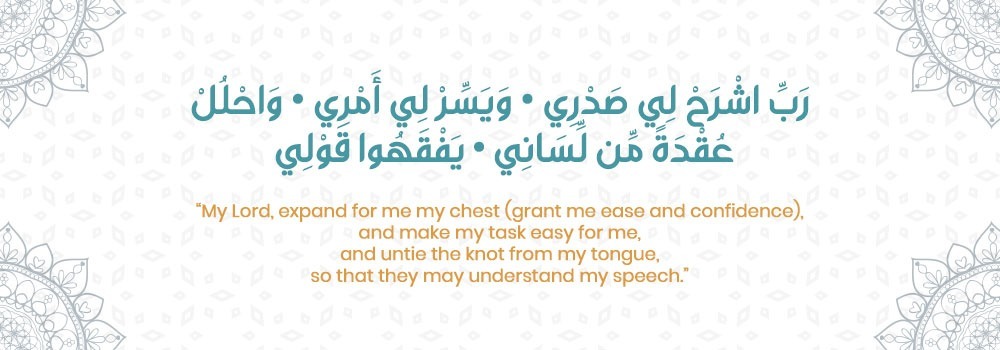
1. Dua for Ease In Tasks and Confidence In Speech
رَبِّ اشْرَحْ لِي صَدْرِي • وَيَسِّرْ لِي أَمْرِي • وَاحْلُلْ عُقْدَةً مِّن لِّسَانِي • يَفْقَهُوا قَوْلِي
Transliteration: Rabbi ishrah li sadri Wa yassir li amri Wahlul ‘uqdatan min lisani Yafqahu qawli
Translation: My Lord, open my heart for me, make my task easy, remove the difficulty from my speech, so people can understand what I say.
Recite this Dua: Before speaking, presentations or interviews, Before teaching or explaining something, When feeling nervous or overwhelmed.
2. Dua for Increase In Knowledge
رَّبِّ زِدْنِي عِلْمًا
Transliteration: Rabbi zidni ‘ilma.
Translation: My Lord, increase me in knowledge.
Recite this Dua: Before studying or reading Quran. Before learning something new. Before classes or exams.
3. Dua of Trust When Facing Fear or Challenge
إِنَّنِي مَعَكُمَا أَسْمَعُ وَأَرَى
Transliteration: Innani ma‘akuma asma‘u wa ara
Translation: Indeed, I am with you both - I hear and I see
These are words of Allah which gave Musa the strength to overcome his fear.
Recite this Dua: When feeling afraid. During uncertainty or danger. When facing a difficult situation.
4. Dua of Reliance On Allah
كَلَّا إِنَّ مَعِيَ رَبِّي سَيَهْدِينِ
Transliteration: Kalla inna ma‘iya rabbi sayahdin.
Translation: No - my Lord is with me. He will guide me.
When to Recite: When feeling trapped or hopeless. When plans fail. During major life difficulties.
5. Dua for Forgiveness and Mercy
رَبَّنَا ظَلَمْنَا أَنفُسَنَا
Transliteration: Rabbana zalamna anfusana
Translation: Our Lord, we have wronged ourselves.
Recite this Dua: After making a mistake. When feeling guilt. During repentance (tawbah).
These duas from Surah Taha are powerful because they come from real moments of fear, responsibility, learning, and repentance. And these are the same situations we experience more often in our lives. So, keep reciting these in routine lives to strengthen the faith.
Final Words
In conclusion, Surah Taha is full of lessons and guidance regarding each aspect of one's life. Even its revelation had a significance in the Islamic history which works the same for today's believers. So, reading Surah Taha during difficult situations or while dealing with difficult people strengthens the faith and will power.
FAQs
Which prophet is most mentioned in Surah Taha?
This surah is mainly about the life of Prophet Musa. So, it mentioned Musa the most throughout the surah. His story teaches patience, trust in Allah and courage to speak truth.
What is the main lesson of Surah Taha?
The main lesson of this surah is to put sincere trust in Allah and patience in hardships. This surah teaches us that divine plan always lead us to the right outcome, even if the path seems long.
Is there a specific time to read Surah Taha?
No, one can read surah Taha anytime to get its spiritual benefits. It's the attentive reading and reflection that matters not the specific time.
How can I apply Surah Taha in daily life?
To apply the lessons of surah Taha in daily life, it's important to add important Dua's from this surah to routine life. And the best way is to connect these Dua's to specific conditions like stress or anxiety.
Is Surah Taha suitable for beginners studying the Qur’an?
Yes, beginners can also read this surah and get its benefits by reflecting over its lessons. Its narrative style is also easier to follow as compared to other chapters of the Quran which are mostly require deep analysis.
Can non-Arabic speakers understand the depth of Surah Taha?
Yes. Though this surah has unique linguistic beauty, the core meaning and lessons of surah Taha are clear through translation and explanation.
.jpg)